Best Cut of Beef to Use for Beef Burgundy
I t'southward a mystery to me how this behemothic of the French classical repertoire has escaped the clutches of this column for so long. Richard Olney (another big beast of the Gallic cookery scene) describes boeuf bourguignon equally "probably the most widely known of all French preparations", while Elizabeth David introduces information technology every bit "a favourite among those carefully composed, slowly cooked dishes, which are the domain of French housewives and owner-cooks of modest restaurants rather than of professional chefs".
Sounds manageable. Still Olney goes on, slightly worryingly, that "beef burgundy certainly deserves its reputation – or would if the few details essential to its success were more oftentimes respected. There is nothing hard about its preparation, but in that location are no shortcuts." And David doesn't help the situation, with the blusterous assertion that "such dishes do not, of grade, have a rigid formula, each cook interpreting it co-ordinate to her taste".
According to Larousse Gastronomique, la bourguignonne refers to anything (generally "poached eggs, meat, fish or sauteed chicken") cooked with red wine and "usually garnished with small onions, button mushrooms and pieces of fat bacon". That much nosotros know. Everything else, it seems, is up for grabs.
The beef
While, similar well-nigh stews, this volition work with well-nigh all slow-cooking cuts, chefs accept their own item preferences. Simon Hopkinson and Lindsey Bareham call for "well-hung sinewy beef – chuck, shoulder or shin perhaps" in The Prawn Cocktail Years. Anthony Bourdain's Les Halles Cookbook specifies paleron of beef, which, a helpful butcher informs me, means featherblade. Richard Olney's much lauded French Menu Cookbook suggests Desperate Dan-manner heel (which takes a while to track downwardly) and Michel Roux Jr's The French Kitchen opts for "braising beef (chuck is good but cheek is best)". Harry Eastwood is also a fan of cheek, writing in Carneval that: "My father introduced me to the joys of eating cheeks … [and] it turns out that beef cheeks are the perfect vehicles for a bourguignon since they blot all the flavours in the pan and the meat surrenders completely."
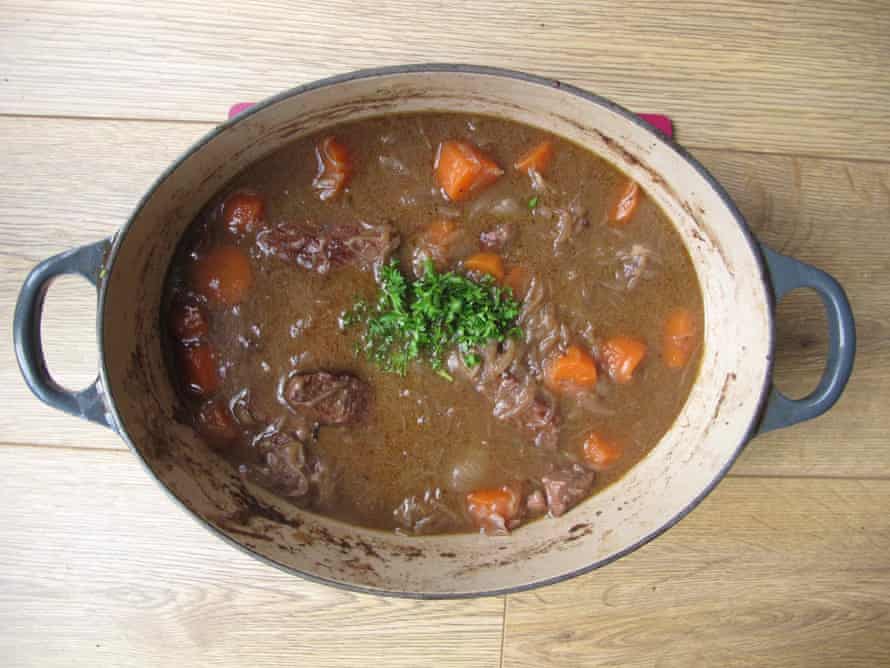
Featherblade proves the to the lowest degree successful with testers – it's just as well lean, which makes it seem rather dry out in comparison with the more gelatinous cuts. A good well-marbled chuck (not always the instance with supermarket versions) does the job, and the more gelatine-rich shin and heel are even improve, but my own favourite is the cheek, which seems to offering the best remainder between meat and cook. Cut it into relatively large chunks because, as Hopkinson and Bareham observe, "A true boeuf à la bourguignonne is non about little cubes of meat stewed in Hirondelle."
Olney's is the only recipe to marinate the meat before utilise; Roux cautions confronting information technology, alarm that "I find this makes for a gamey flavour that's not entirely truthful to the original". Some testers agree, but my problem with information technology is that, far from tenderising the meat, it seems oddly to have dried it out slightly. Whether or not the vino is actually to blame, the meat should have enough of time to absorb its flavour in the oven, rendering such a step pointless.
Hopkinson and Bareham also add a gelatine-rich pig'south trotter to the stew, presumably in order to give it body and richness. This certainly works, but trotters are not always easy for everyone to become hold of. One tester suggests that the more commonly available oxtail might do the same task even better is a skilful one. You can leave it on the os if you like, although I adopt to strip it off after cooking so the meat is more evenly distributed.
The pork
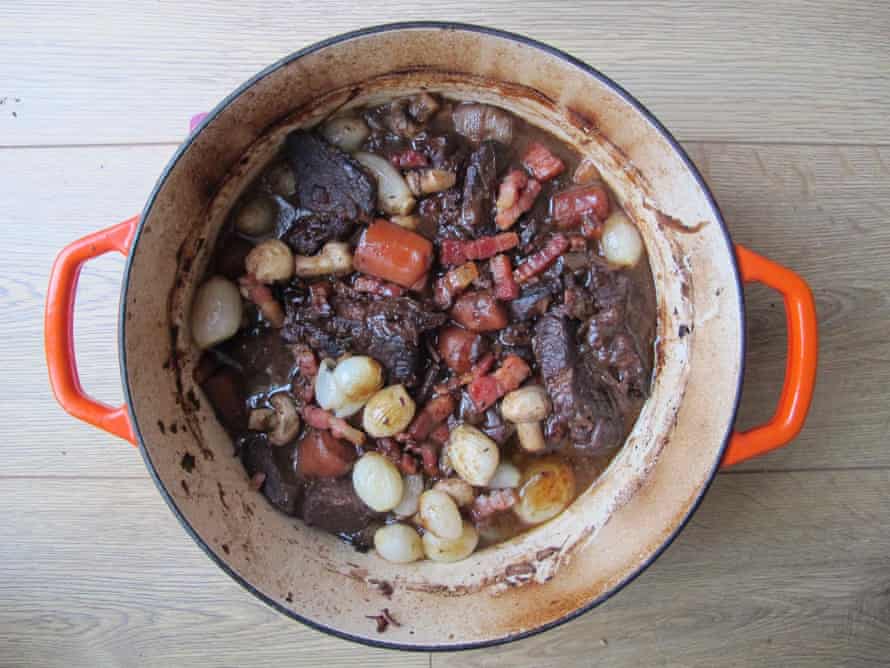
Boeuf bourguignon almost always contains cured pork, too – after all, this is a French recipe, and ii meats are better than one. Certainly my testers are non happy with its omission in Bourdain'southward dish. Olney, who I am quickly learning to fright, warns me that "if good lean salt pork is non available, omit it; do non substitute salary, the smoky flavour of which … distorts and muddles the otherwise clean, distinct flavour of the sauce". Proving that one human being's muddle is some other's masterpiece, Eastwood's smoked lardons and Roux's smoked streaky don't seem to get downwardly besides badly with the panel, but the simpler savoury flavour of greenish bacon seems less likely to distract from the wine, which is, after all, the whole indicate of the dish. (If yous have admission to salt pork, yous may wish to poach information technology briefly before use to tame its aggressive salinity, as Olney does. There's no demand with bacon or pancetta – you lot'll only spoil it.)
The vegetables
The traditional Burgundian garnish of button mushrooms and miniature onions ought to exist not-negotiable, preferably sauteed until golden in the fatty from the bacon, as Eastwood, Olney, Hopkinson and Bareham advise. In this fashion, they absorb some of its savoury richness. The Prawn Cocktail Years recipe adds the vegetables to the stew for the entire cooking fourth dimension, while Roux and Olney cook them through separately, which is a bit of a faff, especially when the one-time demands they're washed in three carve up pans. All very well with a kitchen brigade at your disposal, but I adopt Eastwood'southward method, which adds the the sauteed vegetables to the beef for the final half hr of cooking instead. Much easier.
Instead of the tiny pearl onions near recipes recommend, Bourdain uses the ordinary kind, thinly sliced and caramelised. Some testers like the sweetness they add to the dish, simply we all hold their believing flavor does give his version something of the soupe à l'oignon. If you can't find pearl onions or another atomic variety, small shallots are better than zero.
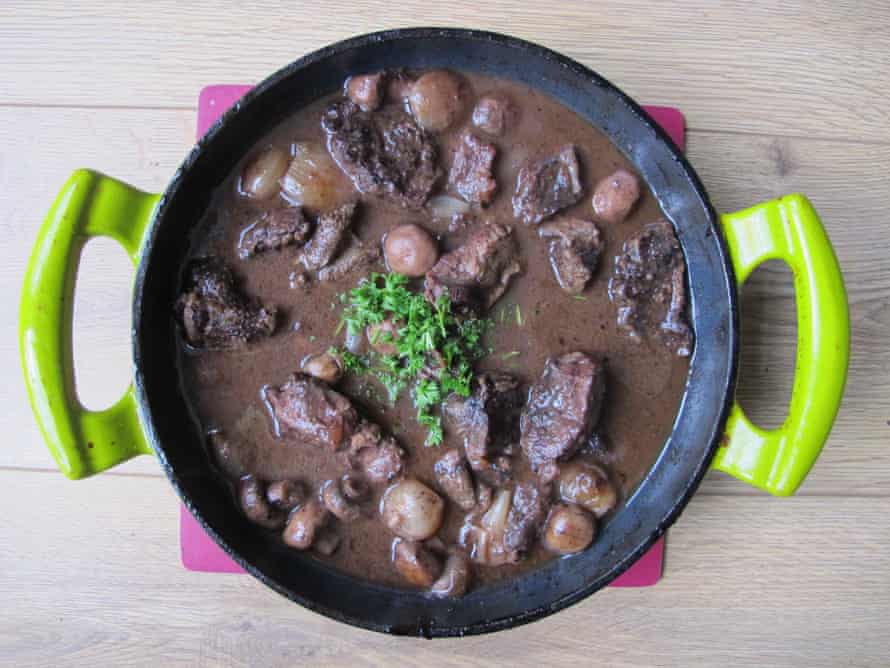
Carrots are also common; the baby variety favoured past Eastwood and Roux brand the most pleasing garnish aesthetically, but ordinary sized ones, cut into large chunks, work only likewise in the flavour department. (The same goes for ordinary mushrooms as opposed to the button sort.)
The liquids
The principal flavour hither ought to be dry out, fruity red wine of the kind produced in Burgundy, although for those of us buying wine in the UK, I'thou not convinced that sticking an actual Burgundian pinot noir into the oven for iii hours isn't a criminal waste of both wine and money (Olney demands a "good red burgundy" no less). I make one with the authentic product (the cheapest I can find over here is virtually £ix) and the rest with an inoffensive but rather cheaper carmine from the south-w, and no one remarks on the difference, even when it's pointed out. So, unless you have an extremely discerning palate, I'd recommend saving your cash for a good burgundy to potable with it instead.
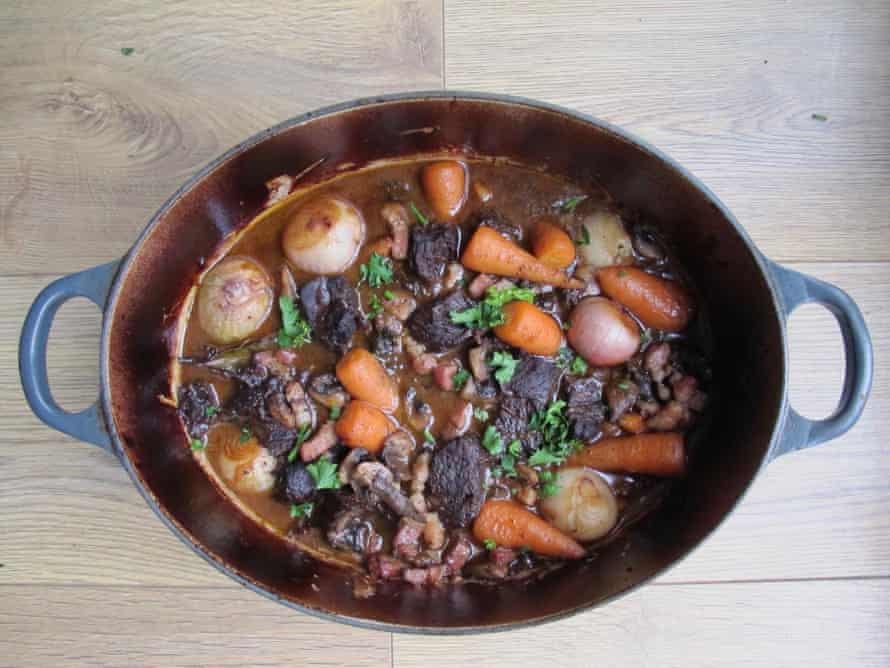
Puzzlingly, Bourdain uses only a cup of vino in his version, which might explicate why everyone describes it as more than similar beefiness stew than a bourguignon, with 1 observing that, "If you added some dumplings it would make a lovely hotpot." A whole bottle is required for maximum touch on, preferably reduced to concentrate its season: Olney does and then later on cooking, but this involves lifting out the meat and vegetables and so warming everything dorsum up together and so it seems far easier to do all the simmering first, as Roux and the Prawn Cocktail Years recommend, so the dish tin exist served straight from the oven. While you're at it, add a few aromatics, as the latter recipe suggests, for a more than rounded gravy.
A splash of brandy, although non absolutely necessary, does add a trivial more complication to the dish. If you don't have it, yet, it's not a disaster.
Other liquids
Most recipes as well use stock of some kind, generally beef, veal or even, for a lighter gravy, Eastwood's craven or vegetable alternative. Bourdain tops up the wine with water instead, and even with his optional couple of spoonfuls of demi slippery, or concentrated veal stock, testers find his gravy sparse and a piddling insipid. "It'south simply very … ordinary." And ordinary is definitely not what we're afterward hither.
Flouring the meat will both help it brown more quickly, and thicken the sauce more than quickly, though it'due south certainly not essential if you would adopt to keep the dish gluten-costless.
Aromatics
Like any respectable French classic worth its salt, boeuf bourguignon benefits from a bouquet garni of bay, thyme and parsley, and a little garlic. If, later on all that hard work, you lot feel it needs a little assistance in the flavour department for some reason (and sometimes it happens), add together a dash of Worcestershire sauce earlier serving, as Eastwood does, although it ought not to require any tomato puree, dijon mustard or indeed Hopkinson and Bareham'southward redcurrant jelly. Add together a nuance of lemon juice if y'all think the dish needs it, but I similar mine unapologetically rich and pasty.
Cooking and serving
You tin melt boeuf bourguignon on the hob – it's no doubt the original method – simply I find it much easier to keep the heat constant in a moderate oven. (Plus it's easier to clean upward after yourself with the pot safely bubbling away out of sight.)
Bourguignon is traditionally served with steamed or boiled potatoes, but Roux proves he's a true Brit by preferring his with brew. Gordon Ramsay's celeriac puree would besides piece of work, as would Julia Child's buttered noodles or rice. Delia Smith, meanwhile, goes for full-on season with pommes boulangère or ratatouille. I concur with Roux, but each to their ain – just every bit long every bit there's wine.
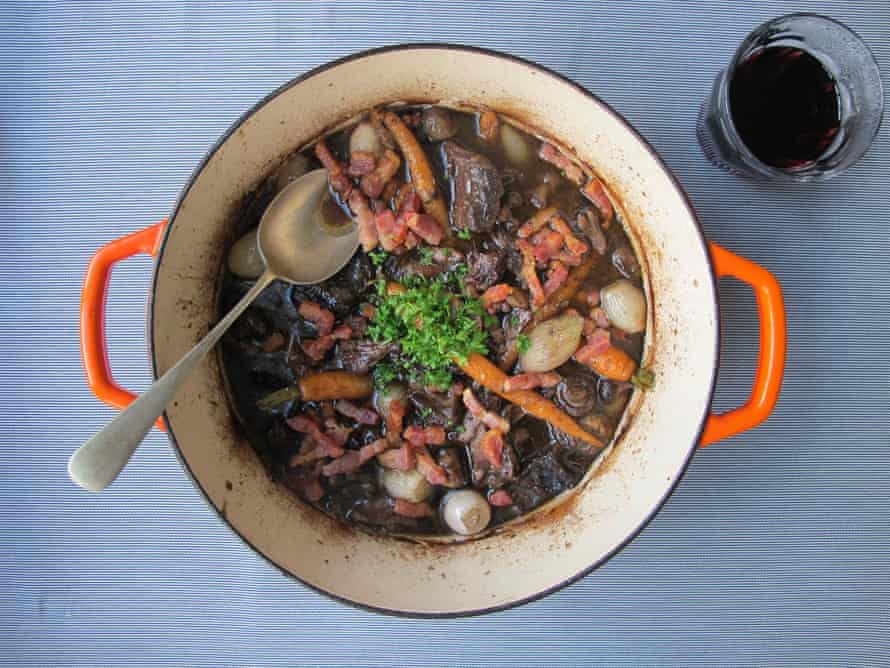
(Serves 6)
1 bottle of fruity, relatively low-cal dry blood-red wine
1 onion, peeled and cut into 6 wedges
1 large carrot, scrubbed and cut into 2cm chunks
ii garlic cloves, peeled and squashed with the back of a pocketknife
one bay leaf,
Small bunch of parsley, plus a handful for garnish
ii sprigs of thyme
2 tbsp olive oil
35g butter
200g unsmoked bacon lardons or a thick slice of unsmoked bacon cut into 2cm cubes
24 pearl onions, or 12 small shallots
18 infant carrots
200g button mushrooms
two tbsp flour
1kg beef cheeks, cut into 3cm chunks
400g oxtail
60ml brandy
250ml skillful beefiness stock
Put the wine in a pan with the onion, carrot, garlic and herbs and bring to the boil. Simmer for thirty minutes until reduced by virtually half. Estrus the oven to 150C.
Heat the oil and butter in a large casserole dish over a medium-high heat, and when the foam has died downwards, add the bacon. Fry until gilt, and so scoop out with a slotted spoon and ready aside.
Add together the bay carrots and mushrooms to the pan and saute until lightly golden, then scoop into a fresh bowl. Add the onions, turn down the heat slightly, and fry until just beginning to brownish. Meanwhile, put the flour on a plate, season, then curlicue the beef in it. Add the onions to the other vegetables and plow up the rut slightly in the pan.
Fry the beef in batches until crusted and securely browned, being careful not to overcrowd the pan or information technology will boil in its own juices (add a little more than oil if it feels like information technology'south called-for rather than browning). Scoop out and prepare aside in a bowl. Turn up the oestrus.
Add the brandy to the pan and scrape to dislodge whatsoever caramelised bits on the bottom. Strain in the reduced vino (discarding the vegetables), followed by the stock. Render the cheeks and oxtail to the pan and bring to a simmer.
Encompass and bake for two and a half hours, then tip in the pearl onions, mushrooms and carrots and bake for another half an hour.
Scoop out the oxtail and strip the meat from the bones. Stir back into the pan with the lardons and season to taste. Add the remaining parsley and serve with mashed potatoes.
Is it a fake economy to brand boeuf bourguignon with whatsoever other wine than red burgundy? What other wines would you suggest serving it with? Which classic Gallic recipes would you like to run into?
Source: https://www.theguardian.com/lifeandstyle/wordofmouth/2017/mar/09/how-to-cook-the-perfect-boeuf-bourguignon
0 Response to "Best Cut of Beef to Use for Beef Burgundy"
Post a Comment