Document Restoration and Preservation With Good Reviews in Southeast Us

The conservation and restoration of books, manuscripts, documents and ephemera is an activity dedicated to the preservation and protection of items of historical and personal value made primarily from paper, parchment, and leather. When practical to cultural heritage, conservation activities are mostly undertaken past a conservator. The principal goal of conservation is to preserve the lifespan of the object as well as maintaining its integrity by keeping all additions reversible. Conservation of books and paper involves techniques of bookbinding, restoration, paper chemistry, and other fabric technologies including preservation and archival techniques.[i]
Book and paper conservation seeks to prevent and, in some cases, reverse damage due to treatment, inherent vice, and the surround. Conservators determine proper methods of storage for books and documents, including boxes and shelving to forbid further impairment and promote long term storage. Carefully chosen methods and techniques of active conservation tin both reverse harm and prevent further impairment in batches or single-detail treatments based on the value of the book or document.
Historically, book restoration techniques were less formalised and carried out by various roles and preparation backgrounds. Nowadays, the conservation of paper documents and books is ofttimes performed by a professional conservator.[ii] [three] Many paper or book conservators are members of a professional body, such as the American Institute for Conservation (AIC) or the Guild of Bookworkers (both in the U.s.a.), the Archives and Records Association (in the United Kingdom and Ireland), or the Institute of Conservation (ICON) (in the United kingdom).[four]
Definition [edit]
Conservation of books and paper involves preserving and stabilizing the material as it is while retaining every bit much of the original materials equally possible.[5] Conservation differs from restoration which involves returning a book or manuscript to new condition with the utilize of more invasive techniques and less preservation of original materials.[five] Preservation is an umbrella term which encompasses conservation and restoration; however, the terms are sometimes used incorrectly when referring to library and archive conservation.[6] The master goal of mod conservation is to maintain the integrity of the original parts of the object and that any additions due to restoration must be reversible.[seven] There are ii approaches of conservation: active or interventive conservation and passive or preventive conservation.[eight] Agile conservation involves evaluating the status of an object and treating to prevent further decay past cleaning, repairing, and restoring when necessary. In preventative conservation, the science of storage and display are employed in gild to command and stabilize the environmental weather affecting the object in order to prolong its life span.[9] Conservation incorporates the fields of bookbinding, restoration, paper chemical science, and other material technologies including preservation and archival techniques.[10]
Considering conservation is one instance of effort to preserve materials, it can exist considered a subcategory of preservation.[11] Conservation oftentimes accompanies preservation strategies such as proper storage and brandish, environmental monitoring, handling preparation, reformatting and security.[12] Notwithstanding, there are many nuances to conservation and conservators must make decisions about how they volition treat the object based on how it will exist used or displayed. For example, library conservation requires that the books be legible and usable, just not necessarily aesthetically pleasing. On the other hand, a book or document to be displayed in an exhibit may need to exist presented in a more visually appealing condition.[13] Newspaper-based items, such as books, scrapbooks, manuscripts, letters, journals and diaries, certificates, maps, deeds, newspapers, drawings, miniatures, and postcards present distinctive concerns when information technology comes to intendance and conservation. Different works of art on paper, these items are oftentimes handled directly and repeatedly to access information.[14] Even newspaper ephemera like newspapers and letters may be significant historical records or family unit mementos.[15]
History [edit]

The history of early conservation has non yet been written, and early conservators recorded little of their work. Consequently, modern conservators are responsible for recording the previous conservation work they find when evaluating objects.[16] As early as 750 B.C., Old Testament prophets Isaiah and Jeremiah advised on the importance of the preservation of documents for hereafter use.[17] In 1627, Gabriel Naudé published Advis cascade dresser une bibliothèthe which independent a chapter discussing volume preservation.[17] The first substantial work on the bailiwick of book restoration was Alfred Bonnardot's Essai sur fifty'art de Restaurer les Estampes et les Livres, first published in Paris in 1846.[eighteen] [19] Until the tardily-nineteenth century, the preferred practice was to restore objects to newer or amend condition with picayune regard to original way or composition. Yet, modern conservation seeks to treat books and newspaper as piffling as possible.[xiii]
Peter Waters, considered the father of modernistic book conservation, was the conservation coordinator at the National Fundamental Library after the 1966 flood of the Arno in Florence, Italy, and was accompanied by hundreds of conservators from around the world.[20] [21] Before the flood, library conservation was not yet an established field.[22] The water affected one-tertiary of the library collections including periodicals, newspapers, fine prints, maps, posters, and the Magliabechi and Palatine rare-book collections.[23] The flood broke the tradition of maintaining proprietary merchandise secrets and conservation treatments as the disaster necessitated the collaboration of the world's nigh experienced book and paper conservators.[23] One book and paper conservation technique that resulted from this collaboration was the development of the "oestrus-prepare tissue" paper mending.[24] Some other development from the Florence floods was the study of limp vellum binding and its usefulness in conservation due to its resistance to water damage.[25] Experienced in large scale archival disasters, Waters defined seven essential requirements for successful recovery after the flood.[20] The first publication of a standard of exercise for conservators was published in Baronial 1964 in Studies in Conservation by the International Institute for Conservation American Group, now the American Constitute for Conservation (AIC). An updated version was released in 1994.[26]

A newspaper conservator handling a book.
Christopher Clarkson originally coined the term "book conservation" in Florence in 1967 in club to differentiate the early European conservation techniques which sought to preserve just the text of a book. Clarkson argued that "strange marks" and "foreign matter" are important to empathise the book'southward physical history and the social history in which the book resided and that this evidence of use should exist preserved.[27] In 1968, the International Centre for the Study of the Preservation and Restoration of Cultural Property organized an international seminar on the subject of conservation of library materials in Rome.[28] In 1969, the offset university-level conservation briefing occurred at the Academy of Chicago where they published Deterioration and Preservation of Library Materials.[28]
The Book and Paper Group (BGP) is the largest specialty group within the AIC. Through meetings and publications, the BPG exchanges information virtually the conservation of books and newspaper.[29] The BPG releases a journal The Book and Paper Grouping Almanac, on the discipline of book and paper conservation.[30]
Agents of deterioration [edit]
Poor treatment is the main cause of deterioration for books, manuscripts, and ephemera; still, a poor surroundings can also be a cause of deterioration for books and paper.[31] Conservators must take knowledge of agents that cause decay in order to preserve items.[9] Agents of deterioration can include mishandling, light, fluctuating humidity, dust and pollution, fire, water, gas and rut, neglect, and pests and other vermin.[32] Inherent vice is "the quality of a material or an object to cocky-destruct or to be unusually difficult to maintain".[33] Paper, books, manuscripts, and ephemera are prime number examples of materials discipline to inherent vice. Early paper was handmade from plant fibers such every bit flax, hemp, and cotton which are durable and can last for centuries.[2] In the mid-19th century, machine-made paper was introduced, and woods lurid became the most mutual, least expensive ingredient in paper, especially in newspapers. The presence of lignin in wood pulp newspaper causes acid to dethrone the cellulose, which causes the paper to become breakable and discolored over fourth dimension.[34] In addition, newspaper has the natural ability to absorb and retain moisture from the temper, making it decumbent to the growth of mold, fungi, and bacteria.[35] Furthermore, some inks used in old books and manuscripts are harmful to paper. Atomic number 26 gall ink, well-nigh commonly used from the eighth century through the finish of the 19th century, contains acid and tin can corrode the paper in humid conditions.[36]
Insects and vermin are naturally attracted to paper because paper is made of cellulose, starch and poly peptide, materials that provide sources of nourishment.[35] The most common pests are roaches, silverfish, and various types of beetles.[37] Book lice feed on mold spores found on paper and paper-thin, and although they do non cause visible damage, their decomposition and excretions tin can stain paper and may also nourish other pests, continuing the cycle of damage.[2] Freezing collection items can mitigate pests.[37] However, some materials should not be frozen, such as books made with leather, because the cold temperatures may cause the fat to ascent to the surface of the leather resulting in a white or yellow area called a blossom.[37] The apply of insecticides directly on collection materials is not generally recommended. However, if the infestation is severe, and fumigation is the best choice, the affected items should exist separated from the rest of the drove for handling.[35]
Extremes of temperature or relative humidity are damaging from either end of the spectrum (low or loftier).[38] High rut and depression relative humidity can cause newspaper to become brittle and leather bindings to crack.[39] Loftier temperatures and high relative humidity accelerate mold growth, foxing, staining, blooming, disintegration, and "red rot" in leather bindings. Fluctuations in temperatures and humidity may as well cause cockling: a wrinkling or puckering preventing the surface from laying flat.[40] Air quality must likewise be taken into consideration. Dust tends to absorb moisture, providing a suitable environment to attract mold growth and insects.[41] Grit tin also become acidic when combined with pare oils and the surface of newspaper.[35] All kinds of light (sunlight, artificial light, spotlights) tin can be harmful.[36] Light tin can issue in fading, concealment, bleaching, and cellulose breakdown. Some inks and other pigments volition fade if exposed to light, especially ultraviolet (UV) light nowadays in normal daylight and from fluorescent bulbs.[41] Any exposure to light can cause impairment, as the effects are cumulative and cannot be reversed.[39]
Storage methods and materials [edit]
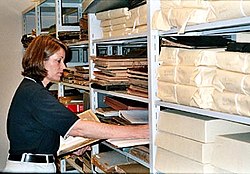
A paper conservator surveying a collection of materials in storage.
Storage in a cool, dry out, clean, and stable location can extend the life of an item.[42] Manuscripts and paper documents are oft stored in protective archival-quality boxes and folders, made of acid-free and lignin-free materials.[43] Documents with heavy use may be stored or encapsulated in a clear polyester (Mylar) film sleeve or folder. As added protection against acrid formation, newspaper-based storage materials may have a buffer, such every bit calcium carbonate, which can neutralize acids equally they course in the storage materials.[43] Boxes should not be overfilled. Items may exist interleaved with acid/lignin-complimentary newspaper.[41] If boxes are but partially full, spacers may exist used, or the box may be stored horizontally.[2] Big format material is best stored in a program cabinet with shallow drawers.[41] The rolling of large items (e.m. maps) should be avoided where possible; but if there is no other selection, the item should be rolled around a big diameter archival quality tube.[44]
Average-size books should exist shelved vertically, side-by-side then they can back up each other.[42] Shelves should not be overpacked and should stand abroad from exterior walls. Oversized or delicate books may exist stored horizontally and completely flat, just stacking should be kept to a minimum.[36] Books may be placed in supportive and protective boxes, to prevent soiling and chafe and to provide structural support. Book boxes may range from elementary four-flap enclosures made of archival safe paper or cardboard to custom clamshell or drop-spine boxes covered in volume cloth.[42]
Until recently, baked enamel steel shelving was considered the best option for volume storage; however, if not properly baked the enamel blanket tin give off formaldehyde and other volatile compounds that can impairment collections. Unless properly baked, enamel-coated shelves are no longer a widely recommended shelving option. Professional testing can confirm that shelves are properly baked. Powder-coated steel shelving prevents off-gassing problems associated with baked enamel. Chrome-plated steel shelving and anodized aluminum shelving are considered other options for metallic shelving, aluminium shelving is considered the optimal choice, particularly for highly sensitive artifacts; even so, it is besides the about expensive. Woods shelving is a more economic option simply the wood must be sealed to preclude the emission of acids and volatiles. The most recommended coating is moisture-borne polyurethane. Paints such as two-role-epoxy, latex, and acrylic tin can too be used, but they vary in their effectiveness and ease of use.[45]
Active conservation and repair techniques [edit]
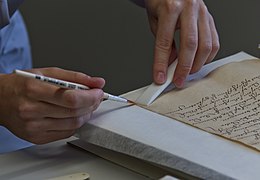
The four stages of conservation include cleaning, stabilization, repair, and restoration. The main objective of cleaning is to achieve clarity of surface item.[46] Books and documents may exist subjected to different types of cleaning. Conservators may make clean dust from newspaper and leather with a soft castor or cloths, a specialized vacuum cleaner, nonchemical vulcanized rubber sponges, or nonabrasive erasing materials such as vinyl erasers.[3] [2] In society to remove mold and insects, conservators employ scalpels, aspirators, or specialized vacuum cleaners. Deep freezing is used to kill the insects.[47] Because some adhesive materials are acidic and stain paper, conservators accept developed techniques to remove agglutinative. Repairs made with water-based adhesives such as animal glue are removed in a h2o bath, by local application of wet, or with poultices or steam. Constructed adhesives and pressure-sensitive (self-adhering) tapes are usually dissolved or softened with an organic solvent before removal.[47] Washing not just removes dirt and aids in stain reduction; it as well washes out acidic compounds and other degradation products that accept built up in the paper. Washing also relaxes brittle or distorted paper and aids in flattening. When washing alone does non combat acidity, conservators employ an alkali metal buffer practical by immersion or past spraying.[47] Flattening follows aqueous handling; paper is placed between blotters or felts nether moderate pressure.[47]
When cleaning and alkalization lone are not sufficient to stabilize the antiquity, conservators may opt to mend and rebind the materials. Mending and filling techniques include narrow strips of torn Japanese tissue adhered with a reversible not-staining adhesive such equally starch paste or methyl cellulose. Newspaper can also be mended with heat-set up tissue repair. Holes or paper losses are filled individually with Japanese newspaper, with paper pulp, or with a paper advisedly chosen to match the original in weight, texture, and color.[48] [47] Books with cleaved sewing, loose or detached boards or leaves require special care.[49] Several techniques are used in conservation binding. The original sewing in a volume is retained if this is possible just is sometimes reinforced using new linen thread and sewing supports.[50] If the original binding is likewise deteriorated, the book may be rebound with new archival safe materials.[51] Weak or brittle paper is reinforced by backing them with another sheet of paper. Japanese newspaper is sometimes used every bit a backing, adhered with a starch paste.[52]
When all-encompassing conservation of the object is impossible or not cost-effective, reformatting techniques are employed to minimize treatments and excessive treatment.[52] Reformatting options include photocopying, digitization, and microfilming. Many libraries and universities take book copiers where the volume can be supported at an angle, avoiding the damage to its construction that can be caused by forcing it flat.[31] [36] In spite of the digital revolution, preservation microfilming is still used. Microfilm can have a life expectancy of 500 or more years, and only needs light and magnification to read.[53]
Mass conservation preserves many books and documents with the aforementioned issues, which reduces the toll of treatment and individual handling. Given the great variety of material found in archival cloth that would require sorting and separate treatments, mass conservation is more often practical to library material than archival material. The just mass conservation handling that tin can realistically be applied to archival material is preventive conservation by ways of temperature and humidity-controlled environments.[54] However, if archival material is sorted past material type, batch treatment can be applied to low to moderate value items. Batch treatment may include humidification, deacidification, or mending. Single-item handling is required for high-value or circuitous books or documents that crave detailed, individual documentation.[55]
Ideals [edit]
Many conservator-restorers bide by a code of ideals determined by a regional professional body, such as that of the American Constitute of Conservation (AIC) for conservation professionals involved in caring for cultural artifacts.[26] Book and paper conservators strive to ensure the integrity of the artefacts on which they work, encompassing the concrete, aesthetic, historical and textual data. One method of applying this is through reversible treatments and alterations, then that repairs tin can be undone in the time to come as techniques evolve and improve. Consequently, volume conservators are trained in the physical and chemical properties of the materials with which they work. Yet, complete reversibility is often impossible, thus conservators must exist conscientious of the long term furnishings of chemical and physical treatments.[56]
Furthermore, conservators must make decisions about which treatments all-time lucifer the forcefulness and material of the object. In some instances, conservators may decide that it is meliorate to store the object and brand a reproduction for use rather than treat it if no treatment options are bachelor due to financial or technological limitations.[56] Moreover, if treatment is used, it must be used every bit sparingly every bit possible to maintain the artful and historical integrity of the artifact.[57] More often than not, conservation techniques aim to mend and stabilize the detail so it tin can be stored and used long-term. Conservators must consider the ethics of how a volume or document should be restored or replicated without losing its aesthetic and historical integrity.[58] Some other ethical aspect of book conservation is the detailed documentation of treatments and alterations including procedures and materials used. Photographic documentation is ordinarily more detailed for unmarried-item treatments than for batch treatments.[59] A trained conservator can observe past treatments washed on the book or document, only skilful documentation specifies the exact techniques and materials used.[threescore]
Historically, there was no codified set of rules for book and paper conservation. According to Andrew Oddy in 1992, "modern scientific conservation is governed by an unwritten set of rules or ideals".[61] There have been many failed attempts to codify these "rules" because conservation requires individual application and is dependent on the goals of the museum and curator; consequently, these approaches cannot be generalized.[61] Paul N. Banks wrote "The Laws of Conservation", also known as The X Laws of Conservation; though never officially published, they have been widely shared by his students.[13]
Sustainability [edit]
Equally part of actions to mitigate climatic change, book and paper conservators increasingly implement sustainability-focused changes to their practice on either a personal or organisational level. Methods for increasing the sustainability of volume and paper conservation piece of work include the responsible sourcing of tools and repair materials (e.g. bamboo spatulas),[62] the use of less industrial chemical solvents and safer chemical alternatives, the utilise of fewer creature-sourced products (e.g. replacing gelatine glues with synthetic ethylene-vinyl acetate emulsions),[63] and reducing the amount of labour and energy required in conservation activities (e.g. preventive treatment measures, using materials sparingly).
In the early on 2000s, conservators determined that preservation of materials should no longer be governed by a universal standard but rather rely on a localized approach.[64] This allows for more than holistic methods determined by the regional climate, resources, historical care practices and collection types.
Gallery [edit]



See besides [edit]
- Preservation (library and archival scientific discipline)
- Inherent vice (library and archival science)
- Mass deacidification
- Foxing
- Conservation and restoration of parchment
- Conservation and restoration of photographs
- Book rebinding
- Radiography of cultural objects including X-ray microtomography combined with digital analysis techniques are methods used to access the contents of sealed documents or fragile scrolls while conserving the integrity of the physical substrate.
- Conservation and restoration of cultural property
- Conservator-restorer
References [edit]
- ^ Banik, Gerhard; Brückle, Irene (2011). Newspaper and water: a guide for conservators. Amsterdam: Butterworth-Heinemann. ISBN978-0-7506-6831-half dozen. OCLC 716844327.
- ^ a b c d eastward "How to Care for Paper Documents and Newspaper Clippings". Canadian Conservation Institute. iv January 2002. Archived from the original on 12 March 2014. Retrieved thirteen Apr 2014.
- ^ a b AIC, "Caring for Your Treasures," American Establish for Conservation of Historic & Artistic Works, Accessed 26 April 2014, [1].
- ^ "What is Conservation". Institute of Conservation. The Institute of Conservation. Retrieved 9 March 2020.
- ^ a b "Preservation and Conservation: Caring for Collections". Emory Libraries & Information Technology . Retrieved 29 January 2020.
- ^ Cloonan 2015, p. xvii.
- ^ Oddy 1992, p. xiii.
- ^ Oddy 1992, p. 21; Ashley-Smith 2018, p. vii
- ^ a b Oddy 1992, p. 21.
- ^ Roberts, Matt T.; Etherington, Don (1982). Bookbinding and the Conservation of Books: A Dictionary of Descriptive Terminology. Washington, D.C.: Library of Congress. p. 64. ISBN0844403660 . Retrieved 12 February 2020.
- ^ "Preservation-Oftentimes Asked Questions". Library of Congress . Retrieved 29 January 2020.
- ^ Cloonan 2015, p. 323.
- ^ a b c Cloonan 2015, p. 324.
- ^ Landrey 2000, p. 31.
- ^ Library of Congress, "Preservation Measures for Newspapers", Accessed thirteen April 2014, [2].
- ^ Oddy 1992, p. x; Cloonan 2015, p. xxiv
- ^ a b Cloonan 2015, p. xxiv.
- ^ Petrov, Ferdinand (2015). The art of painting and the fine art of restoration. Vancouver, British Columbia: Ferdinand Petrov.
- ^ Cloonan 2015, p. xxv
- ^ a b Miller, William; Pellen, Rita M., eds. (2006). Dealing with Natural Disasters in Libraries. New York: The Haworth Press. ISBN9781136791635 . Retrieved 24 Jan 2020.
- ^ Waters 2016, p. 5
- ^ Waters 2016, p. 456.
- ^ a b Waters 2016, p. v.
- ^ Waters 2016, pp. 5–6.
- ^ Etherington, Don (2018). "After Florence: Developments in Conservation Treatment of Books". In Conway, Martha O'Hara; Conway, Paul (eds.). Flood in Florence, 1966: A Fifty-Year Retrospective. Ann Arbor, Michigan: Michigan Publishing Services. ISBN9781607854562 . Retrieved 9 March 2020.
- ^ a b "Cadre Documents: American Institute for Conservation of Historic and Artistic Works" (PDF). American Found of Conservation. American Plant of Conservation. Retrieved 24 Feb 2020.
- ^ Clarkson 2015, p. 328.
- ^ a b Cunha & Cunha 1983, p. 4.
- ^ "Book and Paper Group". American Institute for Conservation. American Institute for Conservation. Retrieved 24 February 2020.
- ^ "The Book and Paper Grouping Annual". The Volume and Paper Group Annual. American Constitute for Conservation. Retrieved 24 February 2020.
- ^ a b Landrey 2000, p. 33
- ^ William Blades (1880). The Enemies of Books. London: Trübner & Co. Retrieved one January 2019.
- ^ National Postal Museum, "Inherent Vice," Smithsonian, Accessed on 13 April 2014, [iii].
- ^ Dava Tobey, "Preserving History," Minnesota Historical Society, Accessed on xiii April 2014, [4].
- ^ a b c d Shelley 1992, p. 30.
- ^ a b c d "How to Care for Books". Canadian Conservation Institute. four Jan 2002. Archived from the original on 12 March 2014. Retrieved 13 April 2014.
- ^ a b c Mary C. Baughman, "Approaches to Insect Problems in Paper and Books," Harry Bribe Center, Accessed 13 April 2014, [5].
- ^ Shelley 1992, p. 29
- ^ a b Shelley 1992, p. 29.
- ^ Cameo, "Cockling", Museum of Fine Arts Boston, Accessed 22 April 2014, [6].
- ^ a b c d State Library of Victoria, "Caring for Works on Paper", State Library of Victoria, Accessed 13 April 2014, [7].
- ^ a b c "Storage Methods and Treatment Practices". Northeast Certificate Conservation Centre. Northeast Certificate Conservation Middle. Retrieved 5 February 2020.
- ^ a b Sherelyn Ogden, "Storage Enclosures for Books and Artifacts on Paper," Northeast Certificate Conservation Heart, Accessed 22 Apr 2014, [8].
- ^ Landrey 2000, p. 42
- ^ Ogden, Sherelyn. "Storage Furniture: A Brief Review of Current Options". Northeast Document Conservation Centre. Northeast Document Conservation Center. Retrieved 9 March 2020.
- ^ Oddy 2015, p. 351.
- ^ a b c d e NEDCC, "Conservation Treatment for Works of Art and Unbound Artifacts on Newspaper," Northeast Document Conservation Middle, Accessed 26 April 2014, [9]
- ^ Schechter 1999, pp. x–17
- ^ Landrey 2000, p. 45.
- ^ NEDCC, "Conservation Handling for Bound Materials of Value," Northeast Document Conservation Center, Accessed 26 April 2014, [x]
- ^ "Guidelines for Library Bounden". Northeast Document Conservation Centre. Northeast Certificate Conservation Heart. Retrieved 9 March 2020.
- ^ a b "Conservation Treatment for Works of Art and Unbound Artifacts on Paper". NEDCC. Northeast Document Conservation Center. Retrieved 19 Feb 2020.
- ^ Steve Dalton. "Microfilm and Microfiche". Northeast Certificate Conservation Centre. Accessed 22 Apr 2014.
- ^ Ritzenthaler 2015, p. 374.
- ^ Ritzenthaler 2015, pp. 374–375.
- ^ a b Ritzenthaler 2015, p. 375.
- ^ Ritzenthaler 2015, p. 376.
- ^ Ritzenthaler 2015, pp. 376–377.
- ^ Ritzenthaler 2015, p. 377.
- ^ Pickwoad 2015, p. 368.
- ^ a b Oddy 1992, p. 12.
- ^ Peachey, Jeff. "bamboo spatulas". Peachey Conservation. Archived from the original on 6 February 2015. Retrieved 10 November 2021.
- ^ "Evasol". Conservation Supplies Australia . Retrieved x Nov 2021.
- ^ Dardes, Kathleen; Standiforth, Sarah. "Preventive Conservation: Sustainable Stewardship of Collections". The Getty Conservation Institute. Getty Conservation Research Foundation Museum. Retrieved nineteen February 2020.
Sources [edit]
- Ashley-Smith, Jonathan (2018). "The ethics of doing aught". Journal of the Institute of Conservation. 41 (1): 6–15. doi:10.1080/19455224.2017.1416650 . Retrieved 24 February 2020.
- Clarkson, Christopher (2015). "Mininum Intervention in Treatment of Books". In Cloonan, Michele Valerie (ed.). Preserving our Heritage. Chicago: American Library Association. ISBN9781555709372.
- Cloonan, Michele Valerie, ed. (2015). Preserving our Heritage. Chicago: American Library Association. ISBN9781555709372.
- Cunha, George Martin; Cunha, Dorothy Grant (1983). Library and archives conservation: 1980s and across . Metuchen, NJ: The Scarecrow Printing. ISBN0810815877.
- Landrey, George J. (2000). The Winterthur Guide to Caring for Your Collection. Hanover and London: University Press of New England. ISBN9780912724522.
- Oddy, Andrew, ed. (1992). The Art of the Conservator. Washington, D.C.: Smithsonian Institution Press. ISBN1560982292.
- Oddy, Andrew (2015). "Does Reversibility Exist in Conservation?". In Cloonan, Michele Valerie (ed.). Preserving our Heritage. Chicago: American Library Association. ISBN9781555709372.
- Pickwoad, Nicholas (2015). "Distinguishing Between the Good and Bad Repair of Books". In Cloonan, Michele Valerie (ed.). Preserving our Heritage. Chicago: American Library Clan. ISBN9781555709372.
- Ritzenthaler, Mary Lynn (2015). "Excerpts from "Conservation Treatment"". In Cloonan, Michele Valerie (ed.). Preserving our Heritage. Chicago: American Library Clan. ISBN9781555709372.
- Schechter, Abraham A. (1999). Basic Book Repair Methods. Westport, CT: Libraries Unlimited. ISBN1563087006 . Retrieved 9 March 2020.
- Shelley, Marjorie (1992). Bachmann, Konstanze (ed.). Conservation Concerns: A Guide for Collectors and Curators . Washington D.C.: Smithsonian Books. ISBN9781560981749.
- Waters, Shelia (2016). Waters Rising: Letters from Florence. Ann Arbor, Michigan: The Legacy Press. ISBN9781940965000.
External links [edit]
- The American Institute for Conservation of Celebrated & Artistic Works
- National Gallery of Art Works on Newspaper
- AIC'due south Newspaper Conservation Catalog
- The Metropolitan Museum of Art Paper Conservation
- Northeast Document Conservation Center Volume Conservation
- The Canadian Conservation Institute
- The Book and Paper Grouping Almanac
Source: https://en.wikipedia.org/wiki/Conservation_and_restoration_of_books,_manuscripts,_documents_and_ephemera
0 Response to "Document Restoration and Preservation With Good Reviews in Southeast Us"
Post a Comment